- Original release
- Previous episode S09E28 - This equation will change how you see the world…
- Number S09E29
- Country United States
- Genre Special Interest
-
External links
YouTube page
-
Last update
5 juillet 2023 - 09:05
on 11 databases
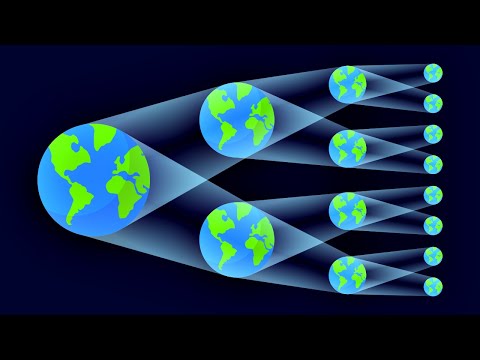
Parallel Worlds Probably Exist. Here’s Why
The most elegant interpretation of quantum mechanics is the universe is constantly splitting
A portion of this video was sponsored by Norton. Get up to 60% off the first year (annually billed) here: https://bit.ly/32SM0yd or use promo code VERITASIUM
Special thanks to:
Prof. Sean Carroll https://www.preposterousuniverse.com
His book, a major source for this video is 'Something Deeply Hidden: Quantum Worlds and The Emergence of Spacetime'
Code for solving the Schrödinger equation by Jonny Hyman available here: https://github.com/jonnyhyman/QuantumWaves
I learned quantum mechanics the traditional 'Copenhagen Interpretation' way. We can use the Schrödinger equation to solve for and evolve wave functions. Then we invoke wave-particle duality, in essence things we detect as particles can behave as waves when they aren't interacting with anything. But when there is a measurement, the wave function collapses leaving us with a definite particle detection. If we repeat the experiment many times, we find the statistics of these results mirror the amplitude of the wave function squared. Hence the Born rule came into being, saying the wave function should be interpreted statistically, that our universe at the most fundamental scale is probabilistic rather than deterministic. This did not sit well with scientists like Einstein and Schrödinger who believed there must be more going on, perhaps 'hidden variables'.
In the 1950's Hugh Everett proposed the Many Worlds interpretation of quantum mechanics. It is so logical in hindsight but with a bias towards the classical world, experiments and measurements to guide their thinking, it's understandable why the founders of quantum theory didn't come up with it. Rather than proposing different dynamics for measurement, Everett suggests that measurement is something that happens naturally in the course of quantum particles interacting with each other. The conclusion is inescapable. There is nothing special about measurement, it is just the observer becoming entangled with a wave function in a superposition. Since one observer can experience only their own branch, it appears as if the other possibilities have disappeared but in reality there is no reason why they could not still exist and just fail to interact with the other branches. This is caused by environmental decoherence.
Schrodinger's cat animation by Ivy Tello
Wave functions, double slit and entanglement animation by Jonny Hyman
Filming of opening sequence by Casey Rentz
Special thanks to Mithuna Y, Raquel Nuno and Dianna Cowern for feedback on the script
Music from https://epidemicsound.com "Experimental 1" "Serene Story 2" "Seaweed" "Colorful Animation 4"

In today's digital age, where information is at everyone's fingertips, it's easy to get swept away by seemingly unbelievable content that inundates our screens daily. Whether it's a mind-boggling viral video or an uncanny photo circulating online, distinguishing fact from fiction has become increasingly challenging. Enter 'Captain Disillusion,' a TV series that not only entertains but educates viewers on deciphering the truth behind visual fakery.
The first season of 'Captain Disillusion' introduces us to a world where appearances are often deceptive, and what you see isn't always what you get. Our titular hero, Captain Disillusion, steps up to guide audiences through this labyrinth of digital deception with his signature blend of humor and analytical prowess. With 106 episodes in its debut season, there's no shortage of content for eager minds ready to learn about the intricate art of debunking.
Each episode serves as a masterclass in skepticism and critical thinking, starting with Episode 1, where Captain Disillusion confronts the bizarre concept of violent penguins and tackles attention-seeking visual effects creators. As we move into Episode 2, the captain turns his vectorscope towards Japan's digital curiosities, unraveling their mysteries with precision.