- Original release
- Previous episode S01E358 - The Hardest Easy Game
- Number S01E359
- Country United States
-
External links
YouTube page
-
Last update
26 octobre 2022 - 16:01
on 11 databases
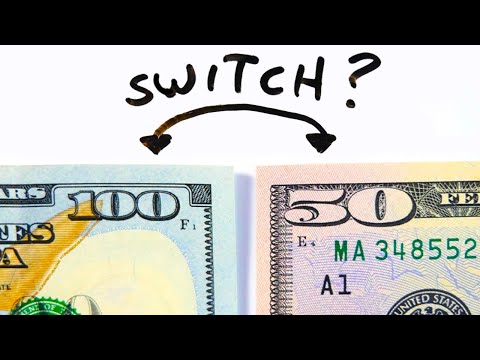
Should You Switch? NO!
Not a real offer, for educational purposes only. I don't have two envelopes filled with money. I don't have any envelopes OR any money.
In The Two Envelopes Paradox -- also called the Exchange Paradox -- you know what the right answer is almost immediately. Until you don’t. And then you do. And then you’re not sure.
The problem isn’t so much the problem itself; it’s figuring out why the setup is wrong. Like several of Zeno’s Paradoxes, we’re lured into thinking about the scenario in a way that leads us down the wrong path… and by the time we realize it, we’re so deep in convincing (or troubling) math that we’ve lost sight of the real issue.
Just like with the Monty Hall Problem, even top academics have trouble elucidating clear, meaningful reasoning for why switching in the Two Envelopes Paradox is or isn’t valuable. That’s why Martin Gardner and others struggled with it for years, and why decades after the paradox (and its variants like the necktie and wallet-switching problems) debuted, it was still of academic interest in math journals and popular recreational mathematics publications.
But the Two Envelopes Paradox is an exercise in logic and probability that continues to be valuable, and probably more so than ever, with implications on how we approach math, science, and the world around us.
*** SOURCES ***
Barry Nalebuff, “The Other Person’s Envelope is Always Greener,” Journal of Economic Perspectives, Winter 1989: https://pubs.aeaweb.org/doi/pdfplus/10.1257/jep.3.1.171
Miles Mathis, “The Two Envelopes Paradox”: http://milesmathis.com/twoen.pdf
Eric Bliss, “A Concise Resolution to the Two Envelopes Paradox”: https://arxiv.org/pdf/1202.4669.pdf
*** LINKS ***
Vsauce2 Links
Twitter: https://twitter.com/VsauceTwo
Facebook: https://www.facebook.com/VsauceTwo
Hosted and Produced by Kevin Lieber
Instagram: http://instagram.com/kevlieber
Twitter: https://twitter.com/kevinlieber
Podcast: https://www.youtube.com/thecreateunknown
Research And Writing by Matthew Tabor
https://twitter.com/TaborTCU
Huge Thanks To Paula Lieber
https://www.etsy.com/shop/Craftality
Get Vsauce's favorite science and math toys delivered to your door!
https://www.curiositybox.com/
Select Music By Jake Chudnow: http://www.youtube.com/user/JakeChudnow
#learning #education #vsauce2

In the vast universe of online entertainment, few shows have made as much impact as "=3". Hosted initially by the charismatic Ray William Johnson, this YouTube web series quickly became a staple for comedy lovers around the globe. With its unique format that combined viral video commentary with sharp wit, "=3" captured the hearts of millions. As it evolved through various hosts like Robby Motz and Kaja Martin, its legacy continued to influence internet culture in profound ways.
The show's inception can be traced back to a time when YouTube was burgeoning with creativity and innovation. Ray William Johnson's dynamic presence and clever humor created an unmatched viewing experience that resonated with audiences seeking laughter and entertainment. His ability to dissect viral videos with humorous insights made "=3" not just a show but a weekly ritual for many fans.
After Ray stepped down in March 2014, Robby Motz took over hosting duties, bringing his own flair while maintaining the essence of what made "=3" so beloved. Although some viewers were skeptical at first, Robby's charm eventually won them over, keeping the fan base engaged and entertained. However, transitions are never easy in long-running shows; when Kaja Martin became the host in July 2015, she faced challenges in retaining viewership amidst changing internet trends.