- Orijinal sürüm
- Önceki bölüm S07E27 - Color changing Tea
- Sayı S07E28
-
Dış bağlantılar
YouTube dosyası
-
Son güncelleme
24 juillet 2023 - 13:29
11 veritabanında
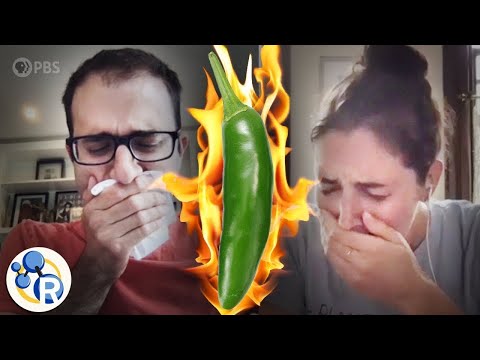
We Found The Best Hot Pepper Cure (It’s Not Milk)
It’s safe to say that we’re all trying to make sense of 2020 — and Self-Evident is aimed at just that. Be sure to check it out! https://www.youtube.com/watch?v=GYs98uc0JjQ
How do you stop pepper burn if you can’t drink milk? This week Sam and George suffer for science. #peppers #burn #spicyfood
You might also like:
How Does Tear Gas Work?
https://www.youtube.com/watch?v=agXnXHfGc3k
The Chemistry of Sriracha: Hot Sauce Science
https://youtu.be/U2DJN0gnuI8
How Does Pepper Spray Work?
https://youtu.be/QFPxj4CcXp0
The Chemistry of Pepper: The Spice that Changed the World
https://www.youtube.com/watch?v=O0kJunDHk8Y
Credits:
Executive Producers:
George Zaidan
Hilary Hudson
Producers:
Andrew Sobey
Elaine Seward
Writer/Host:
Samantha Jones, PhD
Scientific consultants:
John Hayes, PhD
Alissa Nolden, PhD
Michelle Boucher, PhD
Lelia Duman, PhD
Sources:
Capsaicin https://www.ncbi.nlm.nih.gov/books/NBK459168/
The chemistry of a chili
https://www.compoundchem.com/2014/01/15/why-chilli-peppers-are-spicy-the-chemistry-of-a-chilli/
Understand spiciness: mechanism of TRPV1 channel activation by capsaicin
https://www.ncbi.nlm.nih.gov/pmc/articles/PMC5326624/
Capsaicin, Nociception and Pain
https://www.ncbi.nlm.nih.gov/pubmed/27322240
Capsaicin: Risks and Benefits
https://www.uspharmacist.com/article/capsaicin-risks-and-benefits
The paradoxical role of the transient receptor potential vanilloid 1 receptor in inflammation.
https://www.ncbi.nlm.nih.gov/pubmed/19896501
Integrative Approaches to Pain Management
https://www.sciencedirect.com/science/article/pii/B9780323083409000499
The cool science of hot peppers https://www.sciencenewsforstudents.org/article/cool-science-hot-peppers
Unraveling the mystery of capsaicin https://www.ncbi.nlm.nih.gov/pmc/articles/PMC3462993/
Capsaicin: Current Understanding of Its Mechanisms and Therapy of Pain and Other
Pre-Clinical and Clinical Uses https://www.ncbi.nlm.nih.gov/pmc/articles/PMC6273101/
Capsaicin may have important potential for promoting vascular and metabolic health https://www.ncbi.nlm.nih.gov/pmc/articles/PMC4477151/
Capsaicin chemical structure https://pubchem.ncbi.nlm.nih.gov/compound/Capsaicin
Harnessing the Therapeutic Potential of Capsaicin and Its Analogues in Pain and Other Diseases
https://www.ncbi.nlm.nih.gov/pmc/articles/PMC6272969/
Capsaicin: An Uncommon Exposure and Unusual Treatment
https://www.ncbi.nlm.nih.gov/pmc/articles/PMC6682244/
Antimicrobial and Anti-Virulence Activity of Capsaicin Against Erythromycin-Resistant, Cell-Invasive Group A Streptococci
https://www.ncbi.nlm.nih.gov/pmc/articles/PMC4643145/
Perceptual and Affective Responses to Sampled Capsaicin Differ by Reported Intake
https://www.ncbi.nlm.nih.gov/pmc/articles/PMC5383096/
Personality factors predict spicy food liking and intake
https://www.ncbi.nlm.nih.gov/pmc/articles/PMC3607321/
Capsaicin Improves Glucose Tolerance and Insulin Sensitivity Through Modulation of the Gut Microbiota-Bile Acid-FXR Axis in Type 2 Diabetic db/db Mice. https://www.ncbi.nlm.nih.gov/pubmed/31539192
Learning to Like Spicier Food
https://www.theatlantic.com/health/archive/2015/02/learning-to-handle-spicy-food/385606/
Why some people can tolerate the world’s hottest pepper
https://scienceline.org/2016/12/why-some-people-can-tolerate-the-worlds-hottest-pepper/
Advice on building tolerance (from a non-expert) https://www.pepperscale.com/spicy-food-tolerance/
Are People Born With A Tolerance For Spicy Food?
https://www.popsci.com/science/article/2013-06/fyi-are-people-born-tolerance-spicy-food/
Serious Eats on how to build your spicy foods tolerance https://www.seriouseats.com/2010/08/how-to-build-a-tolerance-for-spicy-foods.html
A randomized, double-blind, positive-controlled, 3-way cross-over human experimental pain study of a TRPV1 antagonist (V116517) in healthy volunteers and comparison with preclinical profile.
https://www.ncbi.nlm.nih.gov/pubmed/27168361
Chili peppers for weight loss
https://www.tandfonline.com/doi/abs/10.1080/09637486.2016.1258044?scroll=top&needAccess=true&journalCode=iijf20
Anti-obesity Effect of Capsaicin in Mice Fed with High-Fat Diet Is Associated with an Increase in Population of the Gut Bacterium Akkermansia muciniphila
https://www.frontiersin.org/articles/10.3389/fmicb.2017.00272/full
Milk for chili peppers (Kool Aid?) https://www.sciencedaily.com/releases/2019/06/190625133526.htm
Do Genetics Shape Your Spicy-Food Threshold?
https://firstwefeast.com/features/2016/05/spicy-genetics-investigation/
Ask the doctor: How does hot pepper cream work to relieve pain?
https://www.health.harvard.edu/pain/how-does-hot-pepper-cream-work-to-relieve-pain
Why do some like it hot? Genetic and environmental contributions to the pleasantness of oral pungency
https://www.sciencedirect.com/science/article/abs/pii/S0031938412003095
Produced by the American Chemical Society. Join the American Chemical Society! http://bit.ly/Join_acsmembership