- Original release
- Previous episode S01E35 - ETHEL - Episode 2 (Feat. 12 Parsecs, Alice aux…
- Number S01E36
-
External links
YouTube page
-
Last update
24 juillet 2023 - 12:16
on 11 databases
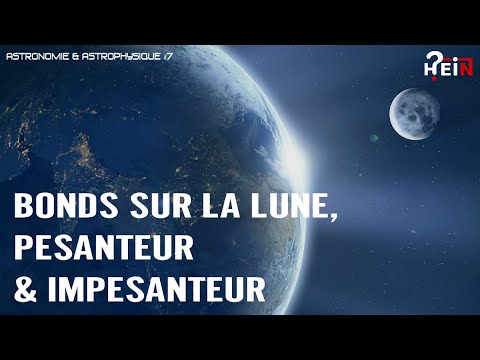
Bonds sur la Lune, pesanteur & impesanteur ?
Pourquoi peut-on faire des bonds sur la Lune? ... Réponse dans cette vidéo!
N'hésitez pas à me proposer des idées de sujets. Pensez à vous abonnez (si ce n'est pas déjà fait), à "liker" et à partager cette vidéo!
Vous pouvez me suivre:
- Twitter: https://twitter.com/hein_rems
- Facebook: https://www.facebook.com/HEIN-193242051167645/
Et me soutenir gratuitement sur Utip! https://utip.io/hein
------------------------------
Correction: (Merci pour vos commentaires)
- à 5:15 c'est le poids d'Albert qui diminue sur la Lune, et non sa masse.
-----------------------------
Le lien pour Google Docs (Sheets):
https://docs.google.com/spreadsheets/d/1eu8AaGKY4-CR9-4rHlqykh3snpIlN-F7vJ8xIOTvc7E/edit?usp=sharing
-----------------------------
SOURCES:
http://www.caabm.org/Documentation/Lune/Gravite/
https://cnes.fr/fr/quest-ce-que-limpesanteur
https://fr.wikipedia.org/wiki/Pesanteur
http://www.neuroreille.com/levestibule/encarts/c_accueil-encart3.htm
https://www.youtube.com/watch?v=79NppovBruY
If you have a passion for astronomy or simply love learning about the universe, then 'AstronoGeek' is a must-watch series for you. This American TV show stands out not just for its educational content but also for its unique approach to making complex topics accessible and entertaining. With just one season comprising 376 episodes, 'AstronoGeek' ensures there's never a dull moment as it delves deep into the mysteries of space.
'AstronoGeek' offers an intriguing mix of historical insights and modern scientific discoveries. The pilot episode sets the tone perfectly by exploring how ancient astronomers like Aristarque de Samos and Hipparque de Nicée measured the distance from Earth to the Moon. It even takes us through modern methods like laser telemetry, which can measure this distance down to a millimeter. The show's creator cleverly uses humor and colloquial language to make these scientific concepts more relatable, proving that science doesn't have to be dry or boring.
One of the standout elements of 'AstronoGeek' is its ability to weave in real-world events with astronomical phenomena. For instance, Episode 2 recounts the infamous blackout in Northeast America on August 14, 2003, when New Yorkers mistook one of nature's most beautiful spectacles for a potential terrorist attack. This blend of storytelling and science keeps viewers engaged while educating them about significant astronomical events.