- Original release
- Previous episode S01E36 - Bonds sur la Lune, pesanteur & impesanteur ?
- Number S01E37
-
External links
YouTube page
-
Last update
24 juillet 2023 - 12:16
on 11 databases
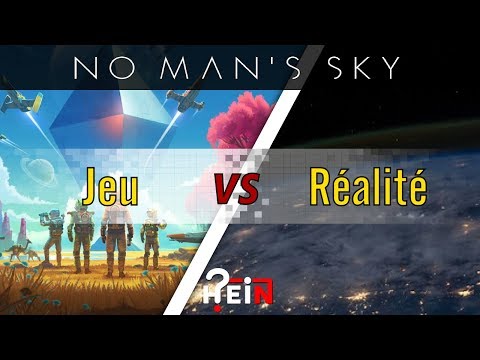
Jeu vs Réalité - No Man Sky ?
Aujourd'hui nous comparons le jeu No Man Sky à la réalité! (Enfin ce que l'on pense savoir en tout cas)
J'espère que la vidéo vous plaira !
Désolé pour les erreurs et les incohérences s'il y en a, croyez que je fais de mon mieux pour vous raconter le moins de conneries possibles.
Bon visionnage à toute et à tous !
P.S: Les jeux vidéos sont fait pour être divertissant et non réaliste (la plupart du temps). Cette vidéo n'est pas une critique visant à pointer les défauts ou donner un avis négatif sur le jeu. Bien au contraire le jeu nous sert de support pour en apprendre toujours plus.
-------------------------------------------------------
N'hésitez pas à me proposer des idées de sujets. Pensez à vous abonnez (si ce n'est pas déjà fait), à "liker" et à partager cette vidéo!
Vous pouvez me suivre:
- Twitter: https://twitter.com/hein_rems
- Facebook: https://www.facebook.com/HEIN-193242051167645/
Et me soutenir gratuitement sur Utip! https://utip.io/hein
-------------------------------------------------------
QUELQUES SOURCES:
https://game-guide.fr/236642-no-mans-sky-guide-des-planetes/
https://sciencepost.fr/2018/11/des-systemes-planetaires-sans-etoiles-sont-ils-possibles/
https://game-guide.fr/236552-no-mans-sky-les-systemes-et-leurs-specificites/
https://fr.wikipedia.org/wiki/Naine_brune
https://fr.wikipedia.org/wiki/%C3%89toile
http://www.odyssespace.fr/etoiles.php
https://fr.wikipedia.org/wiki/Biome
https://fr.wikipedia.org/wiki/Climat
https://fr.wikipedia.org/wiki/Couronne_solaire
http://www.etoile-des-enfants.ch/article2042.html
https://www.dinosoria.com/planetes.htm
https://cral.univ-lyon1.fr/labo/fc/ateliers_2017-18/Atelier2017-11-15/zig_planetes.pdf
https://fr.wikipedia.org/wiki/S/2003_J_2
https://fr.wikipedia.org/wiki/Satellites_naturels_de_Jupiter
https://en.wikipedia.org/wiki/S/2003_J_2
https://nomanssky.gamepedia.com/Weather
If you have a passion for astronomy or simply love learning about the universe, then 'AstronoGeek' is a must-watch series for you. This American TV show stands out not just for its educational content but also for its unique approach to making complex topics accessible and entertaining. With just one season comprising 376 episodes, 'AstronoGeek' ensures there's never a dull moment as it delves deep into the mysteries of space.
'AstronoGeek' offers an intriguing mix of historical insights and modern scientific discoveries. The pilot episode sets the tone perfectly by exploring how ancient astronomers like Aristarque de Samos and Hipparque de Nicée measured the distance from Earth to the Moon. It even takes us through modern methods like laser telemetry, which can measure this distance down to a millimeter. The show's creator cleverly uses humor and colloquial language to make these scientific concepts more relatable, proving that science doesn't have to be dry or boring.
One of the standout elements of 'AstronoGeek' is its ability to weave in real-world events with astronomical phenomena. For instance, Episode 2 recounts the infamous blackout in Northeast America on August 14, 2003, when New Yorkers mistook one of nature's most beautiful spectacles for a potential terrorist attack. This blend of storytelling and science keeps viewers engaged while educating them about significant astronomical events.