- Original release
- Previous episode S01E370 - The Game Of Lies
- Number S01E371
- Country United States
-
External links
YouTube page
-
Last update
26 octobre 2022 - 16:01
on 11 databases
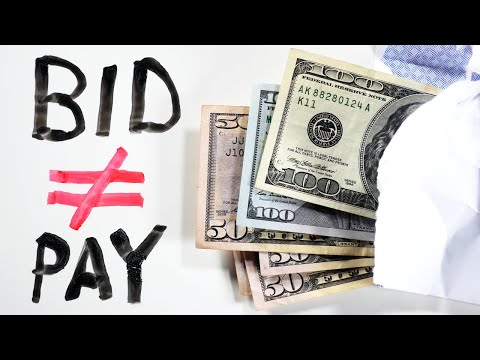
The Auction Problem
The next time you buy a retro game or old t-shirt in an online auction, thank William Vickrey’s 1961 paper, “Counterspeculation, Auctions, and Competitive Sealed Tenders” -- because the simple auction style we take for granted today is actually filled with nuance and complexity.
Auctions have been around as long as one person has had an item to get rid of and at least two people wanted it. From Herodotus’ writing, we know that the ancient Babylonians held auctions over 4,000 years ago. But auctions haven’t changed very much over time, and the general bidding structures have remained intact. It seems like aside from differences like submitting a single private bid vs. open bidding back and forth, there isn’t a lot to adjust.
That couldn’t be further from the truth, as advances in auction theory in economics have changed our understanding of optimal bidding and optimal selling. By formulating the revenue equivalence theorem and working out the sometimes-harmful incentives in different auction formats, Vickrey and those who followed him are making the complexity of everyday transactions invisible.
*** SOURCES ***
Vickrey, William. “Counterspeculation, Auctions, and Competitive Sealed Tenders.” The Journal of Finance, vol. 16, no. 1, 1961, pp. 8–37. www.jstor.org/stable/2977633
Güth, Werner, et al. “A Theoretical and Experimental Analysis of Bidding Behavior in Vickrey-Auction Games.” Journal of Institutional and Theoretical Economics, vol. 139, no. 2, 1983, pp. 269–288. www.jstor.org/stable/40750595
Rothkopf, Michael H., et al. “Why Are Vickrey Auctions Rare?” Journal of Political Economy, vol. 98, no. 1, 1990, pp. 94–109. www.jstor.org/stable/2937643
Rothkopf, Michael H., and Ronald M. Harstad. “Two Models of Bid-Taker Cheating in Vickrey Auctions.” The Journal of Business, vol. 68, no. 2, 1995, pp. 257–267. www.jstor.org/stable/2353115
Lucking-Reiley, David. “Vickrey Auctions in Practice: From Nineteenth-Century Philately to Twenty-First-Century E-Commerce.” The Journal of Economic Perspectives, vol. 14, no. 3, 2000, pp. 183–192. www.jstor.org/stable/2646925
*** LINKS ***
Vsauce2:
TikTok: https://www.tiktok.com/@vsaucetwo
Twitter: https://twitter.com/VsauceTwo
Facebook: https://www.facebook.com/VsauceTwo
Talk Vsauce2 in The Create Unknown Discord: https://discord.gg/tyh7AVm
Hosted and Produced by Kevin Lieber
Instagram: https://instagram.com/kevlieber
Twitter: https://twitter.com/kevinlieber
Podcast: https://www.youtube.com/thecreateunknown
Research and Writing by Matthew Tabor
https://twitter.com/TaborTCU
Editing by John Swan
https://www.youtube.com/channel/UCJuSltoYKrAUKnbYO5EMZ2A
Huge Thanks To Paula Lieber
https://www.etsy.com/shop/Craftality
Music by Basswaite: https://linktr.ee/Basswaite
Select Music By Jake Chudnow: https://www.youtube.com/user/JakeChudnow
Get Vsauce's favorite science and math toys delivered to your door!
https://www.curiositybox.com/
#education #vsauce #maths

In the vast universe of online entertainment, few shows have made as much impact as "=3". Hosted initially by the charismatic Ray William Johnson, this YouTube web series quickly became a staple for comedy lovers around the globe. With its unique format that combined viral video commentary with sharp wit, "=3" captured the hearts of millions. As it evolved through various hosts like Robby Motz and Kaja Martin, its legacy continued to influence internet culture in profound ways.
The show's inception can be traced back to a time when YouTube was burgeoning with creativity and innovation. Ray William Johnson's dynamic presence and clever humor created an unmatched viewing experience that resonated with audiences seeking laughter and entertainment. His ability to dissect viral videos with humorous insights made "=3" not just a show but a weekly ritual for many fans.
After Ray stepped down in March 2014, Robby Motz took over hosting duties, bringing his own flair while maintaining the essence of what made "=3" so beloved. Although some viewers were skeptical at first, Robby's charm eventually won them over, keeping the fan base engaged and entertained. However, transitions are never easy in long-running shows; when Kaja Martin became the host in July 2015, she faced challenges in retaining viewership amidst changing internet trends.