- Country United States
- Original language English
- Genres Comedy, Animation
- Runtime 22 minutes
- Total runtime 122 hours 28 minutes
- Status Continuing
- Network Comedy Central
-
Showrunner
Trey Parker
Matt Stone
- IMDb rating 8.7/10 (450K votes)
-
External links
TheTVDB page
IMDB page
TheMovieDB page -
Last update
21 octobre 2026 - 23:15
on 11 databases -
South Park
Stan Marsh, Kyle Broflovski, Eric Cartman and Kenny McCormick live in South Park, a small town in Colorado. All four are students at the town's elementary school. Stan and Kyle are best friends. Kyle is the intellectual of the gang. But he's Jewish and Cartman can't stand him. Stan is perhaps the quietest of the four kids. Cartman is the mean, rowdy, manipulative, racist, overweight kid. Kenny wears the hood of his anorak so tightly that you can't even see his face and his voice is garbled. Leopold Stotch, nicknamed Butters, is an abused, naive child and the whipping boy. Chef is the cook in the school canteen. Mr. Garrison is the schoolmaster who is quite psychologically disturbed between his whims and his perversities.
The four children will live their daily life between insults and blunders. Anything can happen in South Park, an alien invasion, a contest to become the best *Warcraft* player of all time, the return of the "Savior" or we can meet Tom Cruise, Donald Trump, George Clooney or even Servietsky, a smart towel. Between scatological humor with Little Poo Christmas or mockery of famine and the poor, South Park is the city of all possibilities.

Spoilers ahead for the Season 21 finale of American Dad!, which aired on September 13, 2026. If you watched the finale, you already know that the episode did not try to reinvent the Smith family formula — and that is exactly why it worked. After 21 seasons and 404 episodes, American Dad! remains one of television’s most durable animated comedies because it understands its own engine: Stan Smith’s bottomless confidence, Francine’s underappreciated weirdness, Steve’s vulnerable nerd energy, Hayley’s resistance to family madness, Roger’s infinite capacity for persona-driven chaos, and Klaus’ tragicomic hunger to be taken seriously. The finale leaned directly into that engine with Stan convincing himself he was made for reality TV while Klaus, in peak Klaus fashion, found a way to make his own existence even more pitiful and more hilarious by getting himself “a Klaus.”
What made the Season 21 finale satisfying was not just the absurdity of Stan chasing reality-show glory. American Dad! has always been at its best when Stan’s ego becomes a laboratory for American fantasies: masculinity, fame, patriotism, success, dominance, and the belief that every room is waiting for him to become its main character. Reality TV is a perfect target for him because it rewards self-mythology, humiliation, conflict, and emotional overstatement — all things Stan already produces naturally. The finale understood that Stan does not need to change to become a reality-TV contestant; he already lives like someone waiting for a producer to zoom in on his reaction shot. That made the episode feel less like a parody pasted onto the show and more like a premise that had been sitting inside Stan all along.
The emotional beat underneath the comedy came from the familiar but still effective question: does Stan actually want connection, or does he just want an audience? Season 21 repeatedly returned to that tension. In the pool-party premiere, the Smiths’ domestic life was interrupted by social anxiety, awkward reunions, and a dead rat in the pool — a wonderfully American Dad! symbol for the rot hiding inside cheerful suburban performance. In the flume-ride episode, Stan’s inability to appreciate Francine’s niche interest exposed how often he treats love as something to manage rather than something to experience. In the illness episode, his determination to “power through” became a catastrophic extension of his refusal to admit weakness. By the finale, the reality-TV plot felt like the season’s logical endpoint: Stan trying to convert his flaws into entertainment before realizing, in the show’s typically crooked way, that being watched is not the same as being understood.

Season
Episodes
News (5)



Actors (81)





Videos (4)

(Season 27)

(Season 26)

(Season 25)

(Season 24)
Photos (65)


Similar shows (59)
 Malcolm in the Middle
 Rick and Morty
 The Simpsons
 Disenchantment
 Futurama
 Gravity Falls
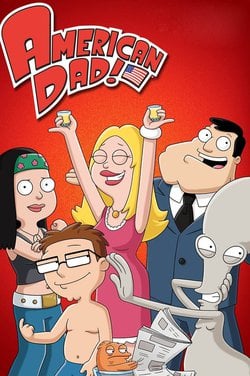 American Dad!
 Les Kassos
 Family Guy
 Archer (2009)
 Adventure Time
 Kim Possible
 F is for Family
 Titeuf
 Daria
 The Boondocks
 Les Lascars
 Happy Tree Friends
 Regular Show
 Brickleberry
 The Cleveland Show
 Tuca & Bertie
 Robot Chicken
 The Wonderful World of Mickey Mouse
 King of the Hill
 Beavis and Butt-Head
 Koala Man
 Metalocalypse
 Chip 'n' Dale: Park Life
 Ugly Americans
 Testees
 China, IL
 Superjail!
 Chozen
 Neighbors from Hell
 Les sales blagues de l'Écho
 Friday: The Animated Series
 Tosh.0
 Mongrels
 Good Vibes
 High School USA!
 Clerks
 Allen Gregory
 La vie est un zoo
 Warren the Ape
 God, The Devil and Bob